 Demon VS Robot DVSR Marketing Website
 Searching for honest information about AI agent platforms in 2026 is harder than it should be. The category is surrounded by promotional content that attributes extraordinary autonomous capability to tools that, in practice, require substantial human investment in workflow design, goal specification, and ongoing oversight to produce professional-quality results. Agentix AI Agents arrives in that promotional environment with claims about goal-driven automation, multi-agent orchestration, and nine-thousand-plus integrations that deserve careful evaluation before any purchase commitment.
Before diving into features, one naming clarification that prevents research confusion: the phrase agentix AI agents appears in two contexts simultaneously in 2026. It refers both to the general paradigm of agentic AI systems that can plan and act autonomously toward goals, and to this specific software product built on that paradigm. Search results mix content about both, which wastes research time if the distinction is not understood upfront. This review covers the software product specifically, evaluated against what it actually delivers for real business workflows rather than what the agentic AI concept promises in theory.
What Is Agentix AI Agents?
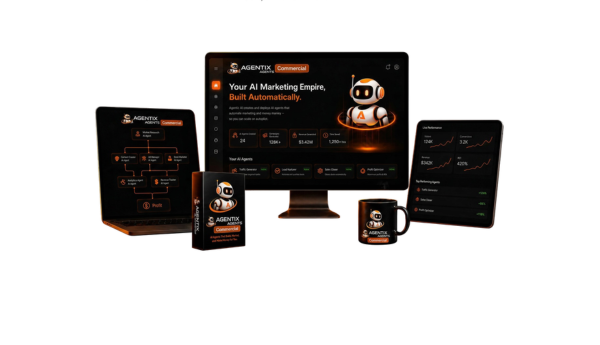
Agentix AI Agents is a cloud-based multi-agent automation platform that deploys goal-driven AI agents capable of planning execution sequences, connecting to over nine thousand business tools, coordinating across specialized agents through an orchestration layer, and completing multi-step workflows with minimal human input. It includes ready-made agent libraries, pre-built workflow templates, commercial licensing, and a no-code dashboard designed for non-technical business users.
The honest framing that every prospective buyer deserves before evaluating individual features: Agentix AI Agents is a workflow automation infrastructure tool that requires deliberate human investment in goal specification, governance architecture, and ongoing monitoring to produce consistent professional-quality outputs. It is not a fully autonomous business operator that handles complex judgment independently without human direction. It is not a passive tool that produces impressive results from minimal input without workflow design investment. And its value is not uniformly applicable across all workflow types regardless of their complexity or execution path variability.
Understanding this positioning precisely enables accurate evaluation rather than the disappointed expectations that inflated autonomy claims produce or the missed opportunity that dismissing a genuinely useful automation platform based on those inflated claims creates.
How Agentix AI Agents Works: A Step-by-Step Walkthrough
Step 1: Goal Definition and Trigger Setup
A workflow objective is entered through natural language, a pre-built template is selected and configured, or an event trigger is established that activates the agent when a specific condition occurs in a connected tool. The specificity and completeness of the goal definition at this stage determines the quality of every subsequent step.
Step 2: AI Planning and Sequencing
The agent analyzes the defined goal, decomposes it into sequential subtasks, identifies which tools are needed at each stage, and establishes the execution order with dependency awareness. This planning step is what distinguishes the platform from rule-based automation: the agent reasons about how to achieve the objective rather than following a pre-programmed path.
Step 3: Cross-System Execution with Logging
The agent executes the planned sequence across connected tools within defined permission boundaries, logging every action for transparency and audit purposes. Exception handling manages anticipated failures; escalation routes unanticipated situations to human review.
Step 4: Verification and Feedback
The agent verifies that intended changes occurred in connected systems, creating a closed-loop quality confirmation. Human feedback where provided improves planning quality on subsequent workflow runs.
Key Features of Agentix AI Agents

Goal-Driven AI Planning
The AI planning capability is the feature most central to Agentix AI Agents' value proposition and the one that requires the most careful honest evaluation because it is both genuinely differentiating and genuinely limited in ways that the marketing framing does not fully convey.
What the planning capability genuinely delivers is the ability to handle workflow variability that rule-based automation cannot serve without exhaustive pre-specification of every possible execution path. When a workflow involves inputs that vary in ways that would require hundreds of conditional rules to handle comprehensively in a rule-based system, the goal-driven agent determines the appropriate handling for each specific instance within its permitted scope. For high-volume workflows with inherent input variability, this adaptive capability is not just an incremental improvement over rule-based approaches but a qualitatively different kind of automation that makes previously impractical workflows automatable.
Multi-Agent Orchestration
The multi-agent orchestration capability coordinates specialized agents across complex workflow stages through an orchestration layer that manages data flow, execution sequencing, and inter-agent handoffs. For workflows where genuinely different capabilities are required at different stages, this architecture enables better per-stage execution quality than a single generalist agent handling every aspect of the process.
The honest assessment for prospective buyers is that multi-agent orchestration provides genuine value when the workflow genuinely benefits from specialized agent handling at different stages, and adds setup complexity without proportional benefit when applied to workflows that a single well-configured agent could execute adequately. Testing whether a specific workflow genuinely benefits from multi-agent coordination before committing to the additional design complexity produces more accurate deployment expectations than assuming the architecture improves all workflows regardless of their specific characteristics.
9,430+ Integration Library
The integration library covering over nine thousand tools is the capability that most directly determines whether Agentix AI Agents can automate the specific workflows in a prospective buyer's actual technology stack. The honest evaluation involves two distinct quality dimensions beyond the headline count.
Coverage accuracy requires verifying that the specific tools critical to the intended automation workflows are present in the current library rather than assuming coverage based on the total count. A library of nine thousand integrations does not guarantee that the twelve specific tools in a particular business's stack are all covered at the depth required for the intended workflows. Checking the current integration documentation for each critical tool before purchase avoids discovering gaps after commitment.
Integration quality requires assessing the depth, reliability, and maintenance currency of specific integrations rather than treating the library as uniform in quality across all entries. An integration that supports only basic read operations for a tool where write operations are required for the intended workflow is a coverage gap regardless of whether the tool appears in the library. Testing critical integrations with representative workflow actions during any available trial period provides more accurate quality assessment than assuming quality from presence in the library.
Ready-Made Agent Library and Pre-Built Workflows
The ready-made agents and done-for-you workflow templates provide deployment acceleration that reduces the time between platform adoption and first productive automation output. For prospective buyers, the honest evaluation involves assessing how closely available templates match the specific workflow requirements that motivate the evaluation rather than accepting template breadth as equivalent to depth within each template category.
Templates that closely match intended use cases provide proven execution structures requiring configuration rather than construction, which genuinely reduces deployment effort and time to value. Templates that require significant modification to serve specific operational requirements may require workflow design investment that the ready-made framing does not fully represent. Testing the closest available templates against actual workflow requirements during any trial period provides the gap assessment that deployment effort planning requires.
Commercial License and White-Label Architecture
The commercial license covering client work and agency service delivery, and the white-label options available through higher-tier plans, are operational requirements rather than supplementary features for professional service businesses building client offerings on the platform. Verifying the specific scope of commercial rights and white-label capabilities against current platform terms for the specific intended applications provides accurate licensing assessment rather than relying on general commercial license framing that may not cover every intended commercial use without qualification.
No-Code Dashboard and Accessibility
The no-code dashboard genuinely reduces the technical barrier to workflow automation deployment for standard workflow types within the integration library. The honest boundary of no-code accessibility is the custom integration layer, where connecting proprietary tools outside the standard library requires API integration skills that the visual configuration interface does not provide. For buyers whose highest-value automation opportunities involve proprietary internal tools, understanding this boundary before purchase prevents discovering it post-commitment.
Governance and Approval Architecture
The approval gate and permission boundary architecture is the feature that most directly determines whether Agentix AI Agents can be deployed responsibly for professional workflows where automation errors have real business consequences. The honest assessment is that the platform provides the governance tools but not the governance design: the decisions about which workflow types at which thresholds require human review, and which have sufficient confidence and low enough stakes to justify full autonomous execution, require organizational judgment that the deploying organization must provide rather than accepting platform defaults.
Treating governance architecture design as an upfront deployment prerequisite rather than a post-deployment refinement produces fundamentally different risk profiles for production automation. Organizations that complete governance design before production deployment encounter automation quality and risk problems less frequently than those that deploy first and address governance reactively.
Pricing Plans and OTOs detailed
Front-End – Agentix AI Agents ($37 one-time)
- One-time payment with lifetime access
- AI-powered multi-agent automation platform
- Ready-made AI agents and workflows included
- Supports 9,430+ tool integrations and cloud automation
- Content creation, research, automation, and marketing tools included
- Multi-agent workflow execution from one dashboard
- Commercial rights included
- No coding or VPS setup required
- Built for marketers, freelancers, agencies, creators, and online businesses
- Can automate content, emails, landing pages, campaigns, and business workflows
- Cloud-based platform with beginner-friendly setup
- 30-day money-back guarantee included
OTO 1 – Agentix AI Unlimited ($97 one-time)
- Removes workflow and execution restrictions
- Unlimited AI agent chains and automations
- 800+ hours of autonomous execution included
- Run multiple workflows simultaneously
- 4K AI image generation included
- International AI voiceovers included
- White-label branding removal included
- Priority processing and cloud storage included
- Advanced training and priority support included
- Commercial usage supported
OTO 2 – Agentix DFY AI Multi-Agent Automation ($97 one-time)
- 30+ done-for-you AI campaign workflows included
- Prebuilt prompts, automations, and AI sequences
- Supports email marketing, funnels, TikTok, Pinterest, and social campaigns
- Landing page and web app workflows included
- Designed for beginners and marketers wanting faster results
- Customize campaigns for any niche
- Automation shortcuts for agencies and freelancers
- Commercial-friendly workflows included
OTO 3 – AI Masterclass 2026 ($67 one-time)
- AI business and monetization training included
- 10 modules covering AI automation and affiliate marketing
- Training for AI agents, prompts, traffic, and online business models
- Uses tools like Agentix AI, ChatGPT, and Claude
- Includes PDFs, workflow exports, and coaching resources
- Weekly updates included
- Built for beginners and marketers wanting step-by-step guidance
- One-time payment with no monthly subscription
OTO 4 – Agentix AI Reseller Agency ($197 one-time)
- Full white-label reseller rights included
- Editable source code and branding control included
- Launch your own AI software business
- Sell on JVZoo, ClickBank, WarriorPlus, and similar platforms
- Offer AI automation services to businesses and clients
- Keep 100% of the profits
- Includes vibe-coding and prompt-to-product training
- Feature expansion rights included
- Built for agencies, freelancers, and SaaS entrepreneurs
OTO 5 – Agentix DFY AI Chatbot Business ($97 one-time)
- Done-for-you AI chatbot SaaS business included
- White-label rights and source code access included
- AI chatbot builder for businesses and agencies
- Deployment training and DFY marketing prompts included
- No coding or developers required
- Includes 5-way monetization blueprint
- Generate recurring revenue through SaaS subscriptions and client services
- Built for local businesses, agencies, freelancers, and entrepreneurs
- Commercial rights included
Advantages of Agentix AI Agents
- Goal-driven adaptive planning handles variable-input workflow categories that rule-based automation cannot serve without becoming prohibitively complex to maintain. For high-frequency workflows with inherent execution path variability, this capability difference is not incremental but categorical.
- Multi-agent orchestration enables end-to-end automation of complex processes requiring genuinely distinct capabilities at different workflow stages. The quality improvement from specialized coordination is proportional to the genuine functional differentiation between stages rather than being uniform across all multi-agent deployments.
- 9,430+ integration breadth covers the majority of standard business tool combinations without custom connector development. For most organizations operating standard business tool combinations, the coverage eliminates the custom integration investment that narrower platform libraries would require.
- Commercial licensing and white-label infrastructure support professional service delivery and proprietary client-facing product development. Explicit use rights and white-label capability address the professional service requirements that agency and consulting operations need clearly resolved before building client offerings on any platform.
- No-code accessibility democratizes powerful automation capability to non-technical operators for standard workflow types within the integration library. The accessibility advantage is genuine for the workflow categories and tool combinations the no-code interface covers without requiring development skills.
Disadvantages of Agentix AI Agents
- Goal specification quality is the primary determinant of output quality in ways that require deliberate skill development rather than intuitive prompting. New users consistently underestimate this dependency before experiencing the quality gap between well-specified and poorly-specified goals in actual deployment.
- Governance architecture design is user responsibility rather than platform default. The tools are available, but the design decisions about appropriate approval thresholds and permission boundaries for specific workflow types require organizational judgment that no platform default configuration can provide appropriately across all use cases.
- Custom integrations with proprietary tools require technical skills beyond the no-code interface. The no-code accessibility boundary is at the standard integration library edge, and workflows involving specialized internal tools outside that library require development investment.
- AI planning errors in connected systems execute consequentially without appropriate output validation and approval gates. The multi-system execution capability that makes Agentix AI Agents powerful also means that planning errors propagate across real business systems rather than producing only incorrect text outputs that a human can discard without consequence.
- Platform dependency on cloud infrastructure requires contingency planning for organizations where consistent automation availability directly affects business operations. Service availability, pricing changes, and feature modifications are outside the operator's control in ways that require proactive rather than reactive risk management.
Who Is Agentix AI Agents For?
- Marketers and business operators with high-frequency multi-step workflows across standard business tools where the coordination overhead between tools consumes disproportionate team time and where the workflow variability makes rule-based automation impractical to maintain without constant rule updates benefit most from the platform's adaptive planning and broad integration coverage.
- Agencies and freelancers building commercial AI automation services who need explicit commercial licensing, production throughput at portfolio scale, and optionally white-label infrastructure for proprietary service positioning find the platform's professional service features directly applicable to their business model requirements.
- Non-technical professionals who want workflow automation leverage for standard business tool combinations and who are prepared to invest in goal specification skill development that produces reliable outputs over the learning curve period find the no-code dashboard genuinely accessible for their intended use cases.
- Growing businesses where workflow volume is scaling faster than team capacity and where the specific workflow types experiencing the most acute capacity pressure involve the variable-input multi-stage characteristics that goal-driven automation serves most effectively.
Who Is Agentix AI Agents Not For?
- Users expecting professional-quality autonomous outputs without deliberate goal specification and governance investment should understand that the operational reality of responsible agentic AI deployment requires human direction and oversight investment that the platform supports but does not provide automatically.
- Organizations with formal compliance requirements governing automated system actions should verify specific regulatory standards against current platform capabilities before deploying in compliance-sensitive workflows rather than assuming general enterprise security descriptions satisfy specific compliance requirements.
- Buyers whose workflow portfolio consists primarily of simple, consistent trigger-action sequences that rule-based automation handles reliably will find Agentix AI Agents' AI planning overhead adds complexity without proportional benefit for those specific workflow types.
Agentix AI Agents vs. The Alternatives: A Detailed Comparison
Criteria | Agentix AI Agents | Zapier | Make.com | n8n | AutoGPT / Open Source | Manual Process |
Goal-Driven AI Planning | Yes | No | No | No | Yes (variable) | No |
Multi-Agent Orchestration | Yes | No | No | Limited | Yes (variable) | No |
Adaptive Execution | Yes | No | No | No | Yes (variable) | Human |
Standard Integration Count | 9,430+ | 6,000+ | 1,500+ | 400+ | Variable | N/A |
No-Code Interface | Yes | Yes | Moderate | No | No | N/A |
Ready-Made Agent Library | Yes | Templates | Templates | No | No | N/A |
Commercial License | Yes | Yes | Yes | Self-hosted | Variable | N/A |
White-Label Options | Yes | No | No | No | Self-built | N/A |
Managed Infrastructure | Yes | Yes | Yes | Self-hosted | Self-hosted | N/A |
Best For | AI adaptive automation | Reliable triggers | Complex rules | Technical custom | Developer experiments | Full control |
Agentix AI Agents earns its place in the automation platform landscape for the specific workflow categories and operator profiles it was designed to serve. It does not earn universal superiority over alternatives regardless of workflow type or organizational context. The evaluation question that produces the most accurate purchase decision is not whether Agentix AI Agents is a good platform in general but whether the specific workflows driving the evaluation are the variable-input, multi-stage, adaptive execution types where goal-driven planning provides the clearest capability advantage over the alternatives best suited to other workflow categories.
Frequently Asked Questions About Agentix AI Agents
- Is Agentix AI Agents a legitimate platform or primarily hype?
Agentix AI Agents is a real platform delivering goal-driven workflow automation capabilities as described. The appropriate skepticism applies to income automation claims in promotional content that attribute business outcomes to autonomous platform operation rather than to the human workflow design, goal specification, and governance investment that effective automation deployment requires. The platform genuinely provides adaptive workflow automation for appropriate use cases. Business outcomes depend on how intelligently the platform is deployed and how effectively its outputs are integrated into actual business operations.
- How does the platform's automation capability differ from rule-based tools like Zapier?
Zapier creates explicit trigger-action sequences where every execution path must be pre-programmed before deployment. When execution encounters a condition the rules did not anticipate, the workflow fails or produces an inappropriate response. Agentix AI Agents uses goal-driven planning to determine the appropriate execution path for each specific workflow instance's characteristics within the agent's permitted scope. For workflows with inherent input variability where exhaustive rule specification is impractical, the adaptive approach produces automation coverage that rule-based alternatives cannot match without becoming maintenance-intensive and brittle at scale.
- What is the most common cause of disappointing results with AI agent platforms?
The most consistent pattern in disappointed user experiences is expecting professional-quality autonomous outputs without investing in the goal specification quality, governance architecture design, and output quality review that responsible production deployment requires. Organizations that approach AI agent platforms as automation infrastructure requiring deliberate human direction consistently produce better business outcomes than those who expect autonomous operation to deliver professional results independently of that direction.
- How should prospective buyers test Agentix AI Agents before committing?
The most accurate evaluation uses actual representative workflow examples from the buyer's specific operations rather than idealized test scenarios, applies the buyer's actual professional quality standards to generate outputs to assess editing requirements, tests the specific integrations most critical to intended automation workflows with representative actions rather than assuming quality from library presence, and draws evaluation conclusions from complete workflow execution experience including the human review and correction investment each workflow requires.
- What governance investment does responsible production deployment require?
Responsible production deployment requires explicitly designing the three-tier approval framework that defines which actions in each workflow type proceed autonomously, which require human review before execution, and which require human execution with agent preparation support. It requires configuring least-privilege permission boundaries that limit each agent's authorized access to the specific systems its defined tasks require. And it requires establishing monitoring protocols that surface execution anomalies for review as a scheduled operational practice rather than as reactive exception handling when customer-visible problems occur.
- What data quality requirements does effective deployment depend on?
Agent execution quality is bounded by the quality of data in connected systems in direct ways that platform capability cannot compensate for. An agent querying a CRM with outdated contact records produces actions based on incorrect information regardless of workflow configuration quality. Assessing the completeness, accuracy, and currency of the data sources that planned automation workflows will depend on before deployment is practical risk management that prevents the data quality problems in connected systems from appearing as automation quality problems that mislead diagnosis and correction efforts.
- How accurate are the nine-thousand-plus integration claims for standard business tools?
The integration library is genuinely broad and covers the majority of commonly used standard business tools. The quality and depth of specific integrations varies in ways that the headline count does not convey. For any workflow where a specific integration is critical to automation value, verifying that the integration supports the specific actions required, not just basic connectivity, and testing it with representative workflow actions during any available trial period provides a more reliable production-readiness assessment than assuming depth from library presence.
- What makes Agentix AI Agents most appropriate for some workflow types and not others?
Workflows most appropriate for goal-driven AI automation combine high execution frequency that makes aggregate time savings significant, input variability that makes rule-based specification impractical to maintain comprehensively, multiple sequential steps across different tools where coordination overhead is substantial, and defined success criteria that allow the agent to verify completion reliably. Workflows less appropriate for this automation approach include those requiring genuine human relationship management as the primary value, those involving complex ethical judgment at each instance, and those with compliance requirements mandating human accountability for every decision rather than only for outputs above defined thresholds.
- How long does it take for deployed workflows to reach consistent professional quality?
Most organizations observe meaningful per-workflow quality improvement over the first two to four weeks of active deployment as goal specification skill develops and configuration refinement based on initial execution data improves output quality. The full productivity benefit, where multiple workflows operate at consistent quality and new workflow configuration becomes efficient through accumulated platform familiarity, typically develops over six to ten weeks of regular platform engagement. Organizations that invest in systematic goal specification development and regular execution log review during this period reach consistent quality faster than those who rely on trial and error without deliberate learning focus.
- What distinguishes organizations that extract genuine value from AI agent platforms from those that are disappointed?
Organizations that consistently extract genuine value treat AI agent platforms as automation infrastructure requiring deliberate human direction, invest in goal specification quality as an organizational capability rather than ad hoc prompting, design governance architecture before ambitious deployment rather than reactively after production problems emerge, and engage with monitoring data as a continuous optimization input rather than an exception reporting system. Organizations that are disappointed typically expect autonomous professional operation without that investment, evaluate the platform against promotional income automation claims rather than documented workflow automation capabilities, or draw conclusions from underdeveloped early deployment rather than the mature configuration that consistent quality requires.
- What should buyers verify before committing to Agentix AI Agents for their specific use case?
Four verification steps produce the most complete pre-purchase assessment. First, confirm that the specific critical integrations for intended workflows are present and sufficiently deep in the current library by reviewing current integration documentation for each critical tool. Second, test available templates against actual representative workflow examples to assess the gap between template starting points and the specific workflow requirements, measuring the configuration work required rather than assuming template categories imply deployment readiness.
Third, review current commercial licensing terms against the specific intended professional applications before building service offerings that depend on those terms. Fourth, assess the governance design requirements for the intended workflows before assuming that default platform configurations are appropriate for the specific stakes and reversibility characteristics of planned production automation.
- What is the honest bottom-line assessment for a prospective buyer in 2026?
Agentix AI Agents delivers genuine capability for goal-driven adaptive workflow automation that rule-based alternatives cannot match for variable-input multi-stage process types, accessible through no-code infrastructure that non-technical operators can deploy without development skills, with commercial features appropriate for professional service delivery. It requires deliberate human investment in goal specification quality, governance architecture design, and ongoing monitoring to produce the professional-quality outcomes its marketing describes.
Buyers who evaluate it against its actual documented capabilities, test it on representative real-world workflow examples, and plan for the governance and specification investment that responsible deployment requires will find it a genuinely valuable automation platform. Buyers whose expectations were shaped primarily by autonomous operation promises will find the required human investment disappointing regardless of the platform's genuine capabilities.
[/tie_list] [/box]- SPECIAL BONUS 1 – MultiNetwork Poster

- SPECIAL BONUS 2 – ContentLynk

- SPECIAL BONUS 3 – AK Booster Pro

- SPECIAL BONUS 4 – FB MultiPoster

- SPECIAL BONUS 5 – GramHood

- SPECIAL BONUS 6 – Serp Scribe

- SPECIAL BONUS 7 – RankMe

- SPECIAL BONUS 8 – RankMe